Compare a repeatable workflow and a written, dated quote. A subscription price alone does not describe the cost—or the fit—of a booking system.

Give every vendor the same scenario
A software comparison becomes useful when each option has to support the same work. Start with a fictional month based on your own operating pattern: number of practitioners, locations, completed bookings, card sales, average transaction size, reminder messages, and expected deposits or refunds. Do not submit real client information to a trial just to make the demonstration feel realistic.
Separate requirements into essential, useful, and optional. An essential might be a processing gap inside a color appointment, different permissions for a receptionist, or a clear client route to reschedule. Name the actual task rather than asking whether a system has “advanced scheduling.” This extends our booking-questions note into a purchasing worksheet.
Calculate the total under stated assumptions
Consider two entirely invented offers for a solo operator collecting $10,000 over 100 card transactions in a month. Offer A charges $30 subscription plus 3% and $0.10 per transaction. Offer B charges $75 plus 2.5% and $0.20 per transaction. Neither is an actual vendor quote.
| Monthly cost component | Example A | Example B |
|---|---|---|
| Subscription | $30 | $75 |
| Percentage processing charge | $300 | $250 |
| Per-transaction charge | $10 | $20 |
| Modeled total | $340 | $345 |
A $45 subscription difference becomes a $5 total difference in this scenario. Different transaction counts, sales volume, payment types, add-ons, or contracts could reverse it. Include setup, hardware, extra users, messaging overages, marketplace charges, and required payment processing as separate lines whenever they apply. Ask whether a quoted rate includes all relevant charges and which country or plan it covers.
Walk through an imperfect appointment
A smooth new booking is only one test. Demonstrate a reschedule, a late arrival, a partial refund, a service change, a failed payment, and a staff member becoming unavailable. Ask what the client sees and what the team must do next.
For example, Square’s US refund guidance, checked 19 September 2026, says the original processing fees are not returned when a payment is refunded. That illustrates why refund treatment belongs in your comparison; it is not a statement about every processor. Check each candidate’s current policy and your agreement.
Test appointment lengths against your capacity plan. Confirm that buffers, processing time, multi-part services, and staff availability behave as intended. A feature name does not prove that your exact workflow works.
Test the exit before the entrance
Ask for a sample export using fictional records. Inspect whether you can retrieve contact details, appointment history, service notes, permissions, formulas, and any attachments you genuinely need. Do not assume a customer CSV includes all of them. Determine what happens to outstanding deposits, gift balances, future bookings, and records after cancellation.
The FTC’s business-data guidance supports limiting information and access to what is needed. For a software evaluation, our practical application is to ask who can view, export, delete, or restore records; whether separate staff accounts and multifactor authentication are available; and how you remove an ex-team member’s access. An attractive interface is not evidence of a complete privacy or security program.
Make a decision you can revisit
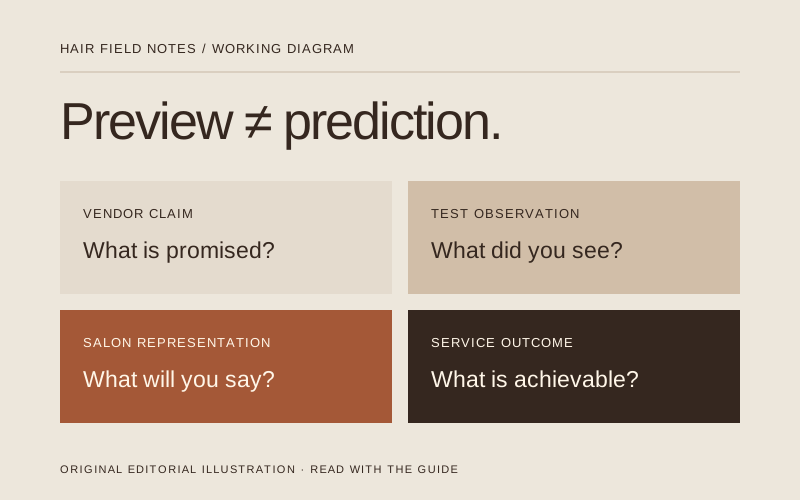
Create a one-page decision record: requirements tested, limitations observed, total modeled monthly cost, quote date, contract length, renewal and cancellation terms, and unresolved questions. Keep the vendor’s written answers with it. Distinguish a salesperson’s promise from a feature you actually exercised.
Run the same simple scenario through each finalist. Choose the arrangement that supports your work at an acceptable total cost and operational burden; do not turn this framework into a universal ranking. Revisit the assumptions when the team, location count, service mix, or contract changes. Current plan prices are deliberately absent here because a durable buying method is more useful than an undated price table.
Sources & context
Sources checked on 19 September 2026. The notes below identify their scope; linking a study is not an endorsement or a clinical review. Worked scenarios and editorial frameworks are our own.
- Square US: Manage customer refunds ↗Vendor policy · checked 2026-09-19
Checked example: original payment processing fees are not returned with refunds. This is a US Square policy example, not a claim about all vendors or a full price comparison.
- FTC: Protecting Personal Information — A Guide for Business ↗Business data-security guidance · checked 2026-09-19
Data minimization, access controls, retention and disposal principles. Salon-specific workflow is editorial guidance, not a jurisdiction-specific compliance policy.
Research drafts are preserved context, not proof for the guide above. Their claims have not all been reverified. Educational information, not medical, legal, or tax advice.