Divide fixed costs by realistically sold service hours—not every hour the door is open. Keep administration, gaps, and overlapping bookings visible.
Find the denominator first
A service-cost worksheet can be mathematically correct and still mislead you if its hourly overhead assumption is too low. That often happens when a monthly bill is divided by every scheduled working hour, even though some of those hours cannot be sold.
Make three separate measures: total work time, appointment time made available, and appointment time actually sold. Total work includes ordering, cleaning, bookkeeping, training, and communication. Available appointment time is the space you deliberately release for bookable services after protecting those tasks. Sold time is the portion occupied by completed appointments, using a consistent definition. None of these measures is a judgment of how hard you work.
Use a small, explicit model
The capacity worksheet uses four inputs: weekly service hours, weeks worked in the modeled month, expected utilization, and monthly fixed overhead. Utilization means sold service hours divided by available service hours. It is an assumption here, not an industry benchmark.
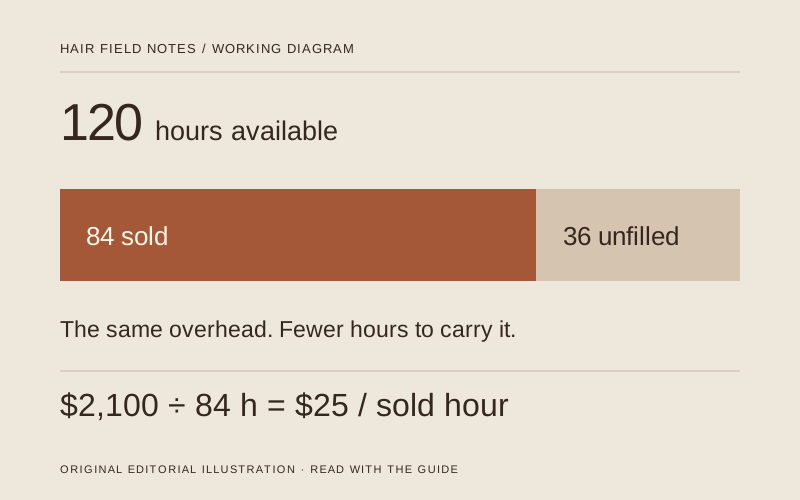
Suppose you offer 30 service hours each week for four weeks: 120 available hours. At 70% utilization, you sell 84 hours. With $2,100 in fixed overhead, each sold hour must carry $25 of that overhead. Dividing by all 120 hours would produce $17.50 and leave $630 unrecovered if you priced as though every available hour sold. This is illustrative arithmetic, not a suggested overhead rate.
| Same monthly overhead: $2,100 | Sold hours | Overhead per sold hour |
|---|---|---|
| 50% of 120 available hours | 60 | $35.00 |
| 70% of 120 available hours | 84 | $25.00 |
| 90% of 120 available hours | 108 | $19.44 |
Use actual weeks or working days for a specific month. Four weeks is merely this example, not a calendar conversion rule.
Decide how to count a service
A booking may occupy a station for two hours but require a different amount of hands-on labor. If you work alone and cannot safely serve another client during processing, the full blocked appointment is relevant to your sellable capacity. If your operation deliberately overlaps work, use a more detailed station-and-labor model; this single-chair worksheet cannot tell you whether overlap is safe or practical.
Keep setup and reset buffers either inside service durations or outside available hours, but not both. Apply the same rule to consultation time. Count a cancellation as sold time only if your chosen measurement actually reflects a paid, retained charge, and distinguish that cash receipt from a performed service. Avoid silently changing definitions to make utilization look stronger.
Connect the calendar to a price
The service-price tool combines time-based overhead and target pay with product costs, then accounts for percentage fees and a retained margin. Carry your realistic overhead-per-sold-hour figure into the service-cost calculator. Do not add the same fixed cost again under product expenses.
The SBA’s break-even explanation separates fixed costs from the contribution left after variable costs. Our capacity model translates that planning idea into a chair-time question; it is not a complete accounting statement. Owner pay, debt payments, equipment replacement, tax, and reserves need their own treatment appropriate to your business.
If the resulting price is not workable for your audience, do not force utilization to 100% to make the sheet agree. Reconsider the service design, cost base, schedule, or business arrangement.
Review a pattern, not one perfect week
Track planned hours, completed hours, cancellations, and unpaid administrative time for several ordinary weeks, including quieter ones. Look for repeated gaps: a slot too short for any service, overrunning appointments, or demand concentrated on a day you rarely offer.
Choose one operational experiment with a review date, such as changing one appointment length or clarifying the booking description. Compare the same measures afterward. More sold hours are not automatically better if rushed consultations, lost breaks, or repeated rework follow. Capacity should describe a sustainable calendar—not a target that asks a person to behave like equipment.
Sources & context
Sources checked on 19 September 2026. The notes below identify their scope; linking a study is not an endorsement or a clinical review. Worked scenarios and editorial frameworks are our own.
- SBA: Break-even point ↗Small-business planning guidance · checked 2026-09-19
Fixed-cost and contribution framework only. All salon figures and scenarios here are original illustrative arithmetic.
Research drafts are preserved context, not proof for the guide above. Their claims have not all been reverified. Educational information, not medical, legal, or tax advice.