Treat an AI image as a consultation aid, not a result guarantee; demand representative testing, clear data terms and substantiation for claims you repeat.
Name the job before the technology
A salon may want a tool to explore color direction, compare haircut silhouettes, collect consultation preferences or sell a product. Those are different jobs. Write one sentence describing the decision the output will inform and one sentence describing what it must never decide. Example: “The preview helps a client discuss warm versus cool direction; it does not predict the chemical result or replace strand history.”
First-party sources confirm that real products exist. ModiFace markets hair-color virtual try-on. Perfect Corp's developer documentation offers image-based hair-color simulation, and its June 2026 release lists hair-color, hairstyle, extension, bangs, volume and wave try-on APIs alongside hair-analysis APIs. Existence is verified; comparative accuracy is not.
Turn the demo into an evaluation set
Ask the vendor to process consented examples representing the salon's real range: light and dark starting colors, gray, vivid color, curls and coils, protective styles, fine edges, high density, low light, multiple skin tones and partial occlusion. Predefine failures such as changing facial features, erasing texture, inventing length, leaking color onto skin or clothing, or presenting an impossible lift as a plausible service. Include images the system rejects; rejection can be safer than a confident wrong preview.
Perfect Corp's API documentation itself specifies image constraints, including minimum dimensions and a visible hair area. That is a reminder that input quality and eligibility belong in the workflow. Do not report an “accuracy rate” unless the vendor defines the task, denominator, dataset, thresholds and date.
Keep four claims separate
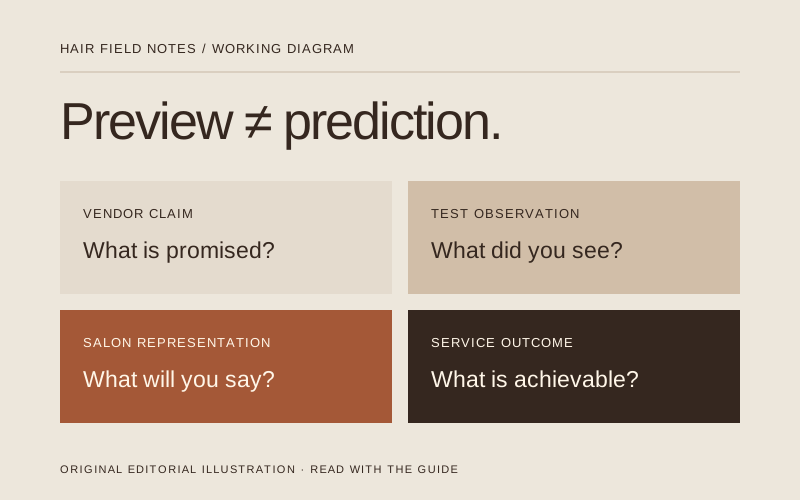
Vendor claim: what the product page says. Test observation: what happened in your bounded evaluation. Salon representation: what staff tell a client. Service outcome: what a qualified professional believes is achievable after history, condition and process are considered. A realistic-looking render can still be a poor forecast.
The FTC's small-business advertising guidance says advertising must be truthful and non-deceptive and advertisers need evidence for express and implied claims. Its 2024 Operation AI Comply announcement makes the practical point that AI does not create an exemption from existing law. If a salon repeats “accurate,” “bias-free,” “perfect match” or outcome claims, ask for the evidence before putting them on a booking page.
Map the image and data path
Before a pilot, document what is captured—live camera, uploaded image, facial landmarks, hair classifications, consultation text or contact details—where processing occurs, how long inputs and outputs are retained, who can access them, whether they train a model, which subprocessors receive them, and how deletion and export work. Obtain the current privacy policy, contract and data-processing terms; do not rely on a sales call summary. The records-and-consent guide provides the next-step worksheet.
Decide whether a client can receive the same consultation without uploading an image. Use specific, plain consent for the preview and separate consent for marketing. Legal duties vary by jurisdiction and implementation, particularly when systems analyze faces or collect sensitive information. This guide makes no conclusion that a named tool complies with a particular privacy or biometric law; obtain qualified advice for the actual deployment.
Run a bounded pilot with an exit
Limit the first pilot by location, service, users and time. Train staff to introduce the image as a visualization, record known failure modes and avoid saving it in the client record by default. Track opt-in, rejection, staff overrides, complaints, time added and whether the preview changed the service decision. Do not use conversion alone as proof of accuracy or client benefit.
Set stop conditions: unexplained face alteration, materially uneven performance across the evaluation set, unclear deletion, contract changes, staff presenting renders as guarantees, or no reliable escalation route. Require an export and deletion plan before launch. At review, retain the tool only if the evidence matches the defined job. A dazzling demo is not the decision rule.
Sources & context
Sources checked on 19 September 2026. The notes below identify their scope; linking a study is not an endorsement or a clinical review. Worked scenarios and editorial frameworks are our own.
- ModiFace · Hair Colour Virtual Try-On ↗Vendor product page · checked 2026-09-19
Verifies that ModiFace currently markets hair-color virtual try-on; all performance language remains a vendor claim.
- Perfect Corp · AI Hair Color Virtual Try-On API documentation ↗Vendor technical documentation · checked 2026-09-19
Verifies the API and selected image constraints; does not provide independent accuracy evidence.
- Perfect Corp · AI Hair & Beard API Suite announcement ↗Vendor announcement · checked 2026-09-19 · source date 2026-06-15
Verifies the vendor's listed 2026 API categories; superlatives and diagnostic performance remain vendor claims.
- FTC · Advertising FAQs: A Guide for Small Business ↗Official business guidance · checked 2026-09-19
Supports truthfulness, non-deception and claim-substantiation principles; not deployment-specific legal advice.
- FTC · Crackdown on deceptive AI claims and schemes ↗Official enforcement announcement · checked 2026-09-19 · source date 2024-09-25
Supports the limited statement that existing unfair/deceptive-practices rules apply to AI marketing; cases were not about salon try-on.
Research drafts are preserved context, not proof for the guide above. Their claims have not all been reverified. Educational information, not medical, legal, or tax advice.