A price is easier to examine when every assumption is visible. Start with your own measured costs.
Measure what the appointment uses
Write down the full time you allocate to an appointment, including preparation and reset. Add the product and consumables used for that service. The worksheet treats these as inputs you provide; its example values are not industry benchmarks.
Give overhead its own line
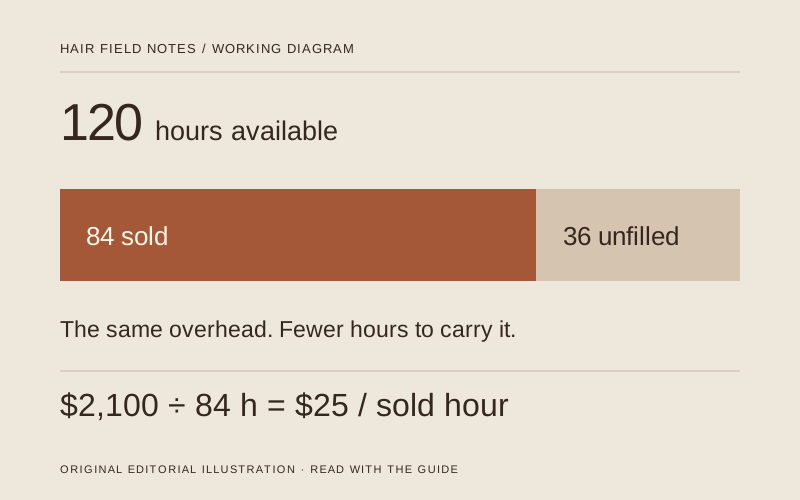
Rent, software, insurance, and other fixed costs still exist between clients. For this simplified model, divide your selected period’s overhead by the hours you expect to bill in that same period. Enter the resulting hourly overhead separately from your hourly pay target.
Keep the arithmetic visible
The model is: (product cost + service hours × (hourly overhead + hourly pay)) ÷ (1 − fee rate − retained margin). With $12 product, 90 minutes, $20 hourly overhead, $30 hourly pay, 3% fees, and 10% retained margin, the modeled price is $100. The $87 base cost leaves $3 for fees and $10 as the chosen margin.
Read the result as a scenario
This is a planning worksheet, not a recommended market price or a take-home earnings forecast. It excludes taxes, tips, flat transaction charges, and any costs you have not entered. The retained margin is after the pay allocation in this model. Try different appointment lengths and check which assumptions change the result most.
Sources & context
An original editorial worksheet developed from the supplied research. It is not an independent test, a clinical conclusion, or a market benchmark.
Read the original research draftResearch drafts are preserved context, not proof for the guide above. Their claims have not all been reverified. Educational information, not medical, legal, or tax advice.