Color results and fiber condition depend on the starting hair, the chemistry used, and cumulative processing—not the shade name alone.
Start with the part of the fiber being changed
If you want to understand a color service, begin with two structures: the cuticle on the outside and the cortex beneath it. The cortex contains most of the fiber's keratin and pigment. Temporary color can sit mainly on the surface; many longer-lasting changes require ingredients to enter the fiber. Oxidative permanent color typically combines an alkalizing system, dye precursors, and hydrogen peroxide. Lightener uses oxidation to remove natural or artificial pigment, but the reaction is not selective for pigment alone. A transmission-electron-microscopy and proteomics study of bleached human hair found structural disruption and oxidation of sulfur-containing amino acids, including conversion of cystine disulfide bonds to cysteic acid (Richena et al., 2018). That finding supports a modest conclusion: lightening can alter both color and fiber proteins. It does not give a universal number of levels that any head of hair can safely lift.
Separate reversible styling from irreversible oxidation
Water and heat can temporarily rearrange weaker interactions in keratin, which is why hair can be set and restyled. Oxidative chemistry is different. In laboratory work using human hair and keratin films, peroxide and commercial bleach produced chemical and microscopic changes, including clearer cysteic-acid formation after oxidation (Kuzuhara, 2012). Once cystine has been over-oxidized to cysteic acid, describing the fiber as simply restored to virgin condition is too strong. Conditioning films, acids, polymers, and specialized treatments may improve friction, feel, water uptake, or breakage performance without erasing the processing history. This distinction matters when a repair claim uses words such as rebuild, reverse, or restore. Ask which measured property improved, on what hair sample, after how many washes, and compared with what control. Those questions are more informative than debating a marketing verb in isolation.
Use a before-the-bowl record
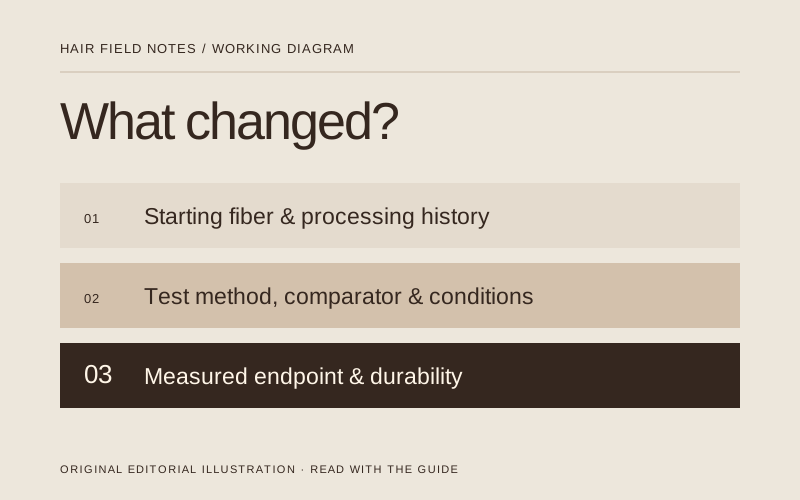
Here is our editorial worked example, not a laboratory protocol. Record four things before formulating: starting canvas (natural depth, previous color bands, visible porosity); intended change (deposit, gray blending, lift, tonal correction); process variables (named product, developer specified by its instructions, placement, time, heat if the manufacturer permits it); and stop conditions (unexpected scalp symptoms, loss of fiber integrity, or a result outside the agreed plan). A strand test can show how a small, representative section behaves under the planned directions, but it cannot guarantee an identical whole-head result or diagnose allergy. For allergy and package testing instructions, use the product label and the consultation approach in Before the color. A fiber test and a skin-allergy assessment answer different questions; one should never be presented as a substitute for the other.
Read the result as cumulative history
Two clients asking for the same photograph may have different constraints because previous lightener, relaxer, permanent wave, heat, weathering, and mechanical wear change the starting fiber. Texture is not a proxy for damage, and coily hair should not automatically be described as weak; assess the actual strand and service history. A useful consultation makes uncertainty visible: what is known, what is reported by the client, what a test section shows, and what remains unknown. The practical decision may be to deposit rather than lift, work in stages, change placement, or decline a process that cannot meet the agreed result within the manufacturer's directions. This guide explains fiber chemistry; it does not set a personalized formula or promise that a particular product prevents breakage. For a framework on evaluating repair products after processing, continue to The evidence behind bond builders.
Sources & context
Sources checked on 19 September 2026. The notes below identify their scope; linking a study is not an endorsement or a clinical review. Worked scenarios and editorial frameworks are our own.
- The physical and chemical disruption of human hair after bleaching—studies by transmission electron microscopy and redox proteomics ↗Primary laboratory study · checked 2026-09-19 · source date 2018-09-19
Supports structural disruption and oxidation of sulfur-containing amino acids in bleached hair; ex vivo fibers, not a clinical safety threshold.
- Effects of oxidative treatments on human hair keratin films ↗Primary laboratory study · checked 2026-09-19
Published in 2012. Supports peroxide/bleach-associated chemical and microscopic changes; keratin films are a model and cannot establish salon outcomes alone.
Research drafts are preserved context, not proof for the guide above. Their claims have not all been reverified. Educational information, not medical, legal, or tax advice.