Ask what a bond product measurably changes; laboratory improvement in a treated tress is not proof that hair has returned to its original state.
Begin with the damage model
Bleaching can oxidize sulfur-containing amino acids and disrupt cuticle and cortex structure. That gives repair products a real problem to address, but bond builder does not identify a single chemistry. Commercial products may use maleate chemistry, peptides, organic acids, proteins, conditioning polymers, or combinations. Some aim to react with sites in damaged keratin; others change surface friction, pH, water uptake, or film formation. Those outcomes can all affect how hair feels or breaks, but they are not interchangeable. The 2018 microscopy and proteomics study in our fiber guide found cystine oxidation after bleach (Richena et al.). It does not establish that every marketed bond treatment reverses that chemistry. First ask whether the evidence used virgin, bleached, relaxed, heat-damaged, or mixed-source hair, because the starting model determines what the result can mean.
Read the test before the headline
A 2024 laboratory study created a bleached-hair protocol and compared two commercial repair products with bleached controls using microscopy, spectroscopy, mechanical measurements, color, and other tests (Martins et al.). It reported product-specific differences, including strength and spectroscopic findings. This is more informative than a before-and-after photograph, but it remains a tress study: application conditions, hair source, wash cycles, sample preparation, and selected endpoints shape the result. It was not a blinded clinical trial of everyday breakage or retained length across textures. One product performing better on one endpoint does not make it universally better, and statistical significance is not automatically a noticeable client benefit. Read the methods, control, number of fibers or tresses, variability, and funding/conflict statement before carrying the conclusion into a service recommendation.
Use a five-question comparison card
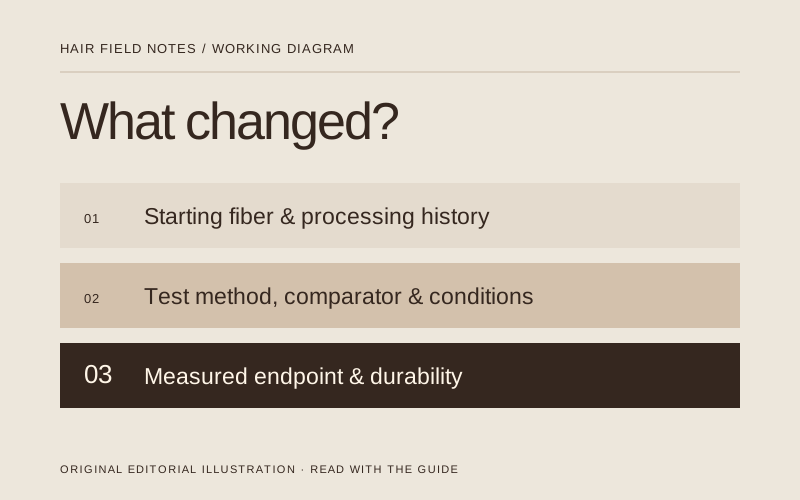
Our editorial framework for any bond claim: 1. Formula: what product and version was actually tested? 2. Model: what prior damage and hair source? 3. Comparator: untreated damaged hair, conditioner, vehicle, or another product? 4. Endpoint: break stress, combing force, microscopy, swelling, spectroscopy, or participant report? 5. Durability: immediate result or after repeated standardized washes? Worked example: if a study reports higher break force immediately after one treatment on double-bleached tresses, write exactly that. Do not translate it into repairs all bonds, prevents hair loss, or works for every texture. Patents and brand diagrams can explain a proposed mechanism, but they are claims to test, not independent confirmation. Likewise, ingredient-list position cannot reveal the effective dose when percentages are undisclosed and the complete formula affects deposition and performance.
Decide what success means at the chair
Choose an observable goal before buying: less breakage during detangling, improved wet combing, better feel, or support during a specified chemical process. Photographing a tress under consistent conditions and recording breakage or combing experience can support salon quality control, but it is not a controlled scientific trial and should never be marketed as one. Keep cutting, conditioning, gentler handling, and reduced repeat processing in the plan; a treatment cannot fuse an already split end into permanently virgin fiber. Stop use and seek appropriate care for scalp symptoms or sudden shedding, which are not evidence that the hair shaft needs more bond product. This guide intentionally excludes lawsuit narratives and obsolete formulation controversies from the original draft: they do not answer whether the current formula, used as directed, achieves a defined fiber endpoint.
Sources & context
Sources checked on 19 September 2026. The notes below identify their scope; linking a study is not an endorsement or a clinical review. Worked scenarios and editorial frameworks are our own.
- The physical and chemical disruption of human hair after bleaching ↗Primary laboratory study · checked 2026-09-19 · source date 2018-09-19
Establishes a bleach-damage model, not efficacy of a repair product.
- Bleached Hair as Standard Template to Insight the Performance of Commercial Hair Repair Products ↗Primary comparative laboratory study · checked 2026-09-19
Commercial-product tress study with multiple endpoints; no human clinical outcomes and not a universal product ranking. The paper discloses project funding and no competing interests.
Research drafts are preserved context, not proof for the guide above. Their claims have not all been reverified. Educational information, not medical, legal, or tax advice.